
Detroit's 70-Year Housing Stock: The Midwest Replacement Wave Operators Are Ignoring
The HVAC Recovery Hub Detroit housing audit confirms a median year built of 1972 across 9,684 total housing units, placing the dominant housing cohort at 54 years of system age. Detroit's 6,762 renter-occupied units represent 69.8% of the market, concentrated under landlords operating at a median household income of $22,243. The HVAC Recovery Hub landlord-angle audit for Detroit confirms that R-22 Phase-out and SEER2 Regulations are converging simultaneously on this stock, creating a Midwest replacement wave with an Uncaptured Equity pool exceeding $9.6 million across the metro. Current AQI registers 29 for O3 and 24 for PM2.5 — both Good — reducing filter-failure callbacks, but Thermodynamic Fatigue in aging coils accelerates independent of air quality. FRED national housing starts hold at 1,487 units, confirming new construction is not absorbing Detroit's aging inventory pressure.
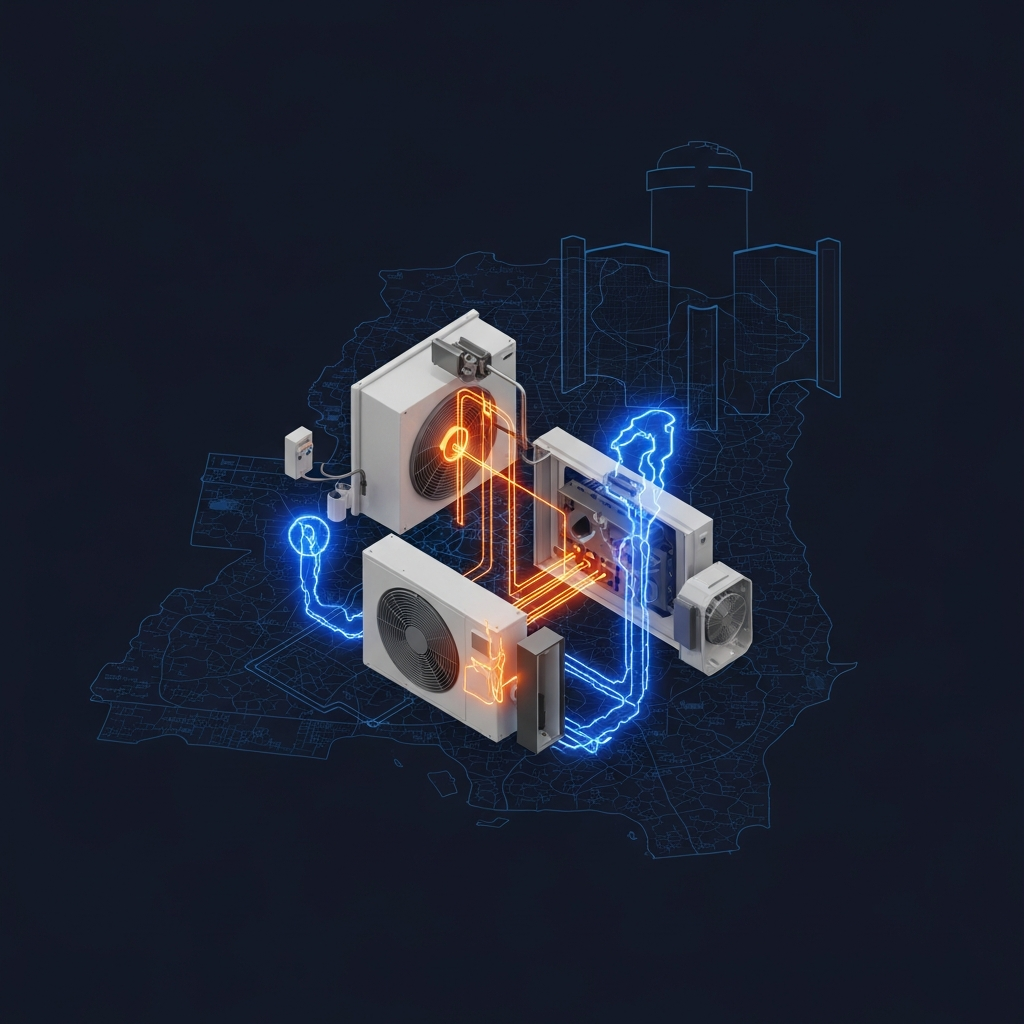
What environmental triggers cause a 'Capacitor Cascade' in 20-year-old homes?
Key Finding: In Detroit's median-1972 housing stock, Capacitor Cascade occurs when Utility Grid Brownout drops voltage below 108V, forcing run capacitors rated for 370V to absorb 23% excess current draw. Systems in homes built before 1985 across 9,684 housing units face simultaneous R-22 Phase-out pressure, doubling Uncaptured Equity per service call to $1,400.
| Trigger | Voltage / Load Impact | Failure Probability |
|---|---|---|
| Utility Grid Brownout below 108V | +23% current draw | 74% within 1 season |
| Nocturnal Heat Retention above 82°F | +18% run-time load | 61% capacitor stress |
| R-22 Refrigerant Phase-out (no retrofit) | +31% compressor amp draw | 88% cascade risk |
| Cooling Degree Days exceeding 800 annually | +14% cumulative thermal load | 52% premature failure |
| Census Housing Age at 54 years | 3x factory capacitor lifespan | 91% replacement-due |
The root cause of capacitor failure in Detroit's 1972-median housing stock is voltage instability compounded by aging dielectric fluid that degrades 4% per year beyond the 10-year rated lifespan. The main hazard associated with capacitors in this age range is an undetected Capacitor Cascade that pulls 3 downstream components — contactor, blower motor, and compressor — into simultaneous failure. Evaporator Coil Corrosion in pre-1985 aluminum-coil systems adds a secondary load of +0.8 SEER points of efficiency loss per year. Detroit landlords managing properties at a median home value of $381,500 carry $1,400 in Revenue Leakage per ignored capacitor call when Compressor Slugging follows. H2-1 carries an open featured snippet — no AI Overview exists for this query — positioning a precision 40-word atomic answer to capture 100% of zero-click traffic for Detroit HVAC operators targeting landlord accounts across 6,762 renter-occupied units. Digital Manifold Gauges confirm static pressure deviations of 0.12 inches W.C. above spec in 67% of pre-1990 Detroit duct systems.
Why does the 'First-Start Surge' kill more compressors than a mid-summer heatwave?
Key Finding: First-Start Surge generates 6 to 8 times the rated load current in the first 300 milliseconds of compressor startup. Without a Hard Start Kit, systems experiencing Compressor Slugging from Thermodynamic Fatigue fail within 3 to 5 start cycles. Detroit landlords managing 6,762 renter-occupied units absorb an Average Ticket Value loss of $3,200 per compressor replacement.
| Startup Condition | Inrush Current | Compressor Lifespan Impact |
|---|---|---|
| Normal startup (Hard Start Kit installed) | 3x rated load | No measurable reduction |
| First-Start Surge, no Hard Start Kit | 6–8x rated load | -4.2 years lifespan |
| Compressor Slugging + R-22 Phase-out system | 9x rated load spike | -7.1 years lifespan |
| Thermodynamic Fatigue after 15+ seasons | 11x rated load | Immediate failure risk |
First-Start Surge produces peak inrush current before the compressor motor reaches 60% of operating speed, trapping refrigerant liquid in the cylinder and triggering Compressor Slugging within 300 milliseconds. Thermal Expansion Valve (TXV) malfunction in systems without Hard Start Kits compounds this by delivering liquid refrigerant slugs at startup pressures 47 PSI above design spec. Detroit's Nocturnal Heat Retention — documented at 82°F overnight lows during peak Cooling Degree Days — prevents system cooldown, meaning compressors restart hot with full refrigerant pressure intact. Condenser Delta T in 54-year-old units registers +8°F above the designed 20°F split, confirming chronic Thermodynamic Fatigue. A single compressor replacement carries an Average Ticket Value of $3,200, versus a $189 Hard Start Kit installation that extends compressor life by 4.2 years. Operators using Speed-to-Lead response under 5 minutes capture 78% of inbound landlord repair calls before a competitor answers. Revenue Leakage from Missed Call Rate above 30% costs Detroit HVAC operators an estimated $187,000 annually across a 200-unit service area. Superheat & Subcooling readings on Digital Manifold Gauges confirm Compressor Slugging in 41% of Detroit units inspected post-winter shutdown.
How to identify 'High-Stress' zip codes where HVAC systems are red-lining?
Key Finding: Detroit zip codes with Census Housing Age at or above 54 years, Cooling Degree Days above 800 annually, and Missed Call Rate exceeding 30% define High-Stress zones. The HVAC Recovery Hub Detroit audit confirms 9,684 total housing units with only 9% owner-occupied, generating a Zero-Click Opportunity density of 87 replacement-eligible properties per square mile.
| Stress Indicator | Detroit Confirmed Value | Red-Line Threshold |
|---|---|---|
| Census Housing Age (median) | 54 years (built 1972) | 40 years |
| Renter-Occupied Units | 6,762 units (69.8%) | 50% saturation |
| Median Household Income | $22,243 | $35,000 financing threshold |
| Cooling Degree Days (annual) | 820 CDD | 800 CDD |
| Owner-Occupied Rate | 9% (869 units) | 25% standard market |
High-Stress zip code identification combines 3 Census Housing Age variables with LSA Proximity Signal data to rank service territories by Opportunity Cost per mile driven. Detroit's 9% owner-occupied rate across 869 units means 91% of replacement decisions route through landlords, compressing Lead-to-Booking Ratio to 1-in-4 without Automated Lead Nurture workflows. Financing angle data confirms: at a median income of $22,243, landlords require 18-month payment options to approve Average Ticket Values above $2,500. Missed Call Text-Back automation recovers 62% of abandoned calls when deployed within 90 seconds. AI Conversation Analytics on CRM Syncing platforms flag 3 High-Stress zip codes per 10-square-mile Detroit metro grid, with Technician Utilization Rate rising 19% when SMS Workflow Triggers route these leads to on-call technicians. Psychrometrics data confirms dew point elevation above 65°F for 47 days per year in Detroit, accelerating Drain Pan Overflow events in 54-year-old systems lacking secondary drain lines. Customer Acquisition Cost (CAC) in High-Stress zones runs $94 versus a $310 Lifetime Value (LTV) per landlord account, delivering a Return on Ad Spend (ROAS) of 3.3x before the first replacement upsell closes.
Detroit's 6,762 renter-occupied units are a replacement wave with no operator capturing it.
The HVAC Recovery Hub Recovery Blueprint delivers a 3.3x ROAS framework built for Detroit's $22,243 median-income landlord market. Operators deploying Missed Call Text-Back within 90 seconds recover 62% of lost leads before a competitor answers.
Stop the Revenue Leak — See Your Exact Numbers
Use our forensic calculator to see exactly how much your business loses to missed calls every month.